
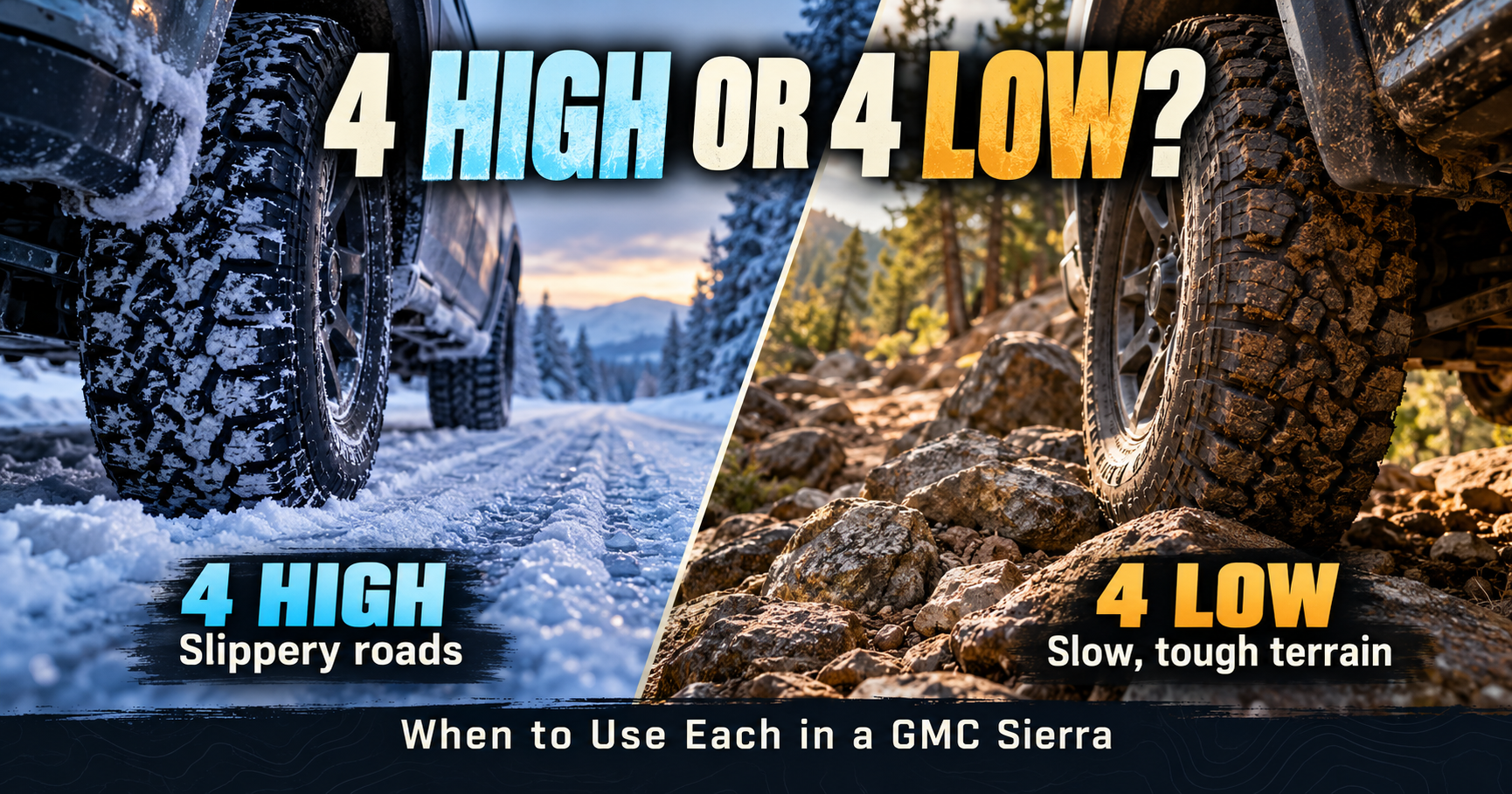
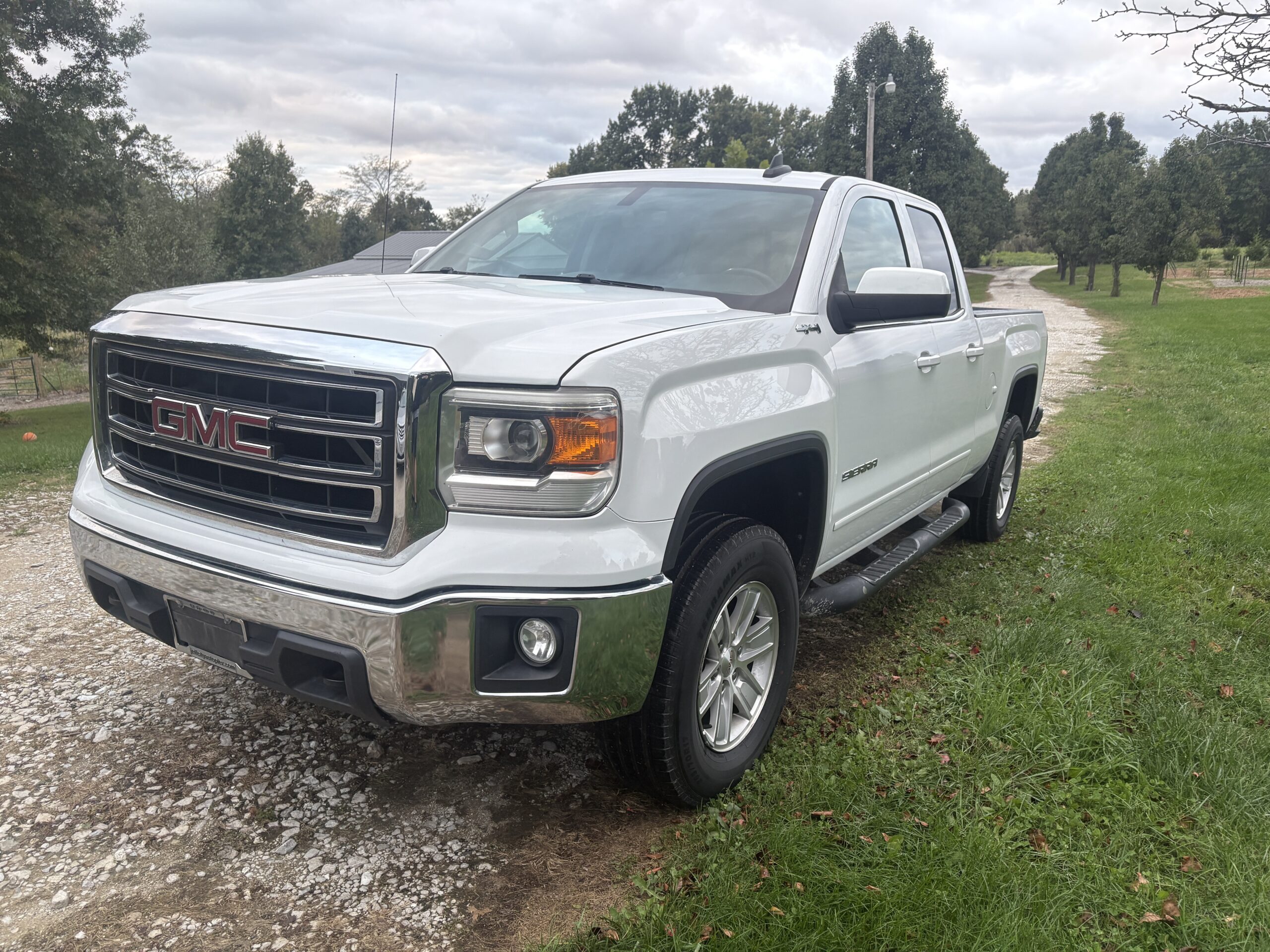
One reason I liked the 2015 GMC Sierra I bought is that it’s a 4×4. But having four-wheel drive and knowing when to use each setting are two different things.
4 High and 4 Low sound like they might simply mean fast and slow. That gets part of the idea across, but it leaves out the important question: what is the truck trying to do in each mode?
For my Sierra, the useful distinction is this: 4 High is for extra traction while driving; 4 Low is for slow situations where the truck needs more pulling power and control. Neither setting makes the tires grip a slippery road better than the tires themselves allow.
GMC offered different four-wheel-drive controls on 2015 Sierras. Some have a floor lever, some have an electronic knob, and some knobs include an AUTO setting. I’d check the controls in my particular truck before following shifting instructions meant for a different version.
What does 4 High actually do?
In 4 High, the truck engages the front axle to help the rear wheels move it. GMC describes it as the setting to use when extra traction is needed, including snowy or icy roads and many off-road situations.
Think of a snow-covered road where the rear tires have trouble getting the truck moving. Having the front wheels help can make a noticeable difference.
That doesn’t mean I’d drive at my usual speed. Four-wheel drive can help a truck get going on a slick surface. It doesn’t give me a shorter stopping distance on ice, and it doesn’t make a corner safe at a speed the tires can’t handle.
For an ordinary dry road, GMC identifies 2 High as the setting for most streets and highways. That’s the one I’d use when I don’t need four-wheel drive.
When would I choose 4 Low instead?
I’d think about 4 Low when the going is slow and difficult, such as deep mud, deep snow, deep sand, or a steep off-road climb or descent.
GMC says 4 Low engages the front axle and delivers extra torque. In plain English, it gives the truck more mechanical advantage at low speed. The truck can work harder without me needing to build up speed and charge at an obstacle.
That last part matters. If I were easing through a deeply rutted, muddy spot, I wouldn’t want to rely on momentum and hope I made it through. 4 Low is intended for the kind of situation where controlled, slow movement is the better approach.
It isn’t the setting I’d select just because rain started falling or because there’s a light coating of snow on a normal road. Those situations call for thinking about traction and speed, not automatically reaching for the lowest gear.
Does 4 Low give the tires more grip?
No. It changes the gearing and how the truck delivers power. It cannot create traction between a tire and a surface that won’t provide it.
A tire spinning on slick mud is still a tire spinning on slick mud. Four-wheel drive can help if another tire has enough grip to move the truck, but neither 4 High nor 4 Low makes the truck immune to getting stuck.
That’s why I’d look at the surface before choosing a setting. Is the road merely slick? Is the truck trying to climb something steep? Is the mud deep enough that I need to crawl rather than drive normally? Those details tell me more than the words “four-wheel drive” alone.
Which setting would I use in snow?
It depends on how much snow and where I’m driving.
For a snow-covered road where I need extra traction at normal driving speeds, 4 High is the setting GMC points to. I’d still leave more room to stop and take turns gently.
For deep snow off-road, where the truck needs to move slowly and work its way through, GMC lists 4 Low as an option.
If a road alternates between clear, dry pavement and slippery sections, I’d pay attention to whether my particular Sierra has an AUTO four-wheel-drive setting. GMC describes AUTO, on trucks equipped with it, as useful when road traction varies. I wouldn’t assume my truck has AUTO without looking at its control.
Which setting would I use in mud?
A muddy road and a truck buried in deep mud aren’t the same problem.
If I just need extra traction to drive across a loose or slick surface, 4 High may be appropriate. If I’m moving through deep mud slowly, 4 Low offers the extra torque GMC intended for that situation.
I’d avoid spinning the tires hard in either mode. Once a tire digs down, more throttle may leave the truck resting on its underside with less chance of driving out.
If I were unsure how deep the mud was, I’d get out and look before driving into it. Four-wheel drive is useful, but it’s easier to avoid a bad spot than to pull a truck out of one.
Can I use 4 High on dry pavement?
For regular dry-pavement driving, I’d leave the Sierra in 2 High, as GMC recommends for most streets and highways.
GMC cautions against driving on clean, dry pavement in 4 High or 4 Low. Those modes are for situations where the tires can slip as needed on a lower-traction surface. On a dry surface, turning can put strain on the drivetrain.
If I came out of a snowy stretch onto a long section of clear road, I’d switch back to the appropriate road setting rather than leave it in 4 High out of habit.
This is one reason I’d rather learn what the controls do while parked at home than try to figure them out for the first time in bad weather.

Can I shift from 2 High to 4 High while moving?
Yes, on the electronic transfer-case versions described in GMC’s 2015 manual, you can shift from 2 High into 4 High while the truck is moving, subject to the manual’s instructions for that system.
For the electronic knob without AUTO, GMC specifies up to 75 mph when shifting into 4 High from a mode other than 4 Low. That is a shifting limit, not advice to drive 75 mph on snow or ice.
For a knob that includes AUTO, GMC says you can select 4 High or AUTO while moving, except when shifting out of 4 Low. The indicator flashes during the shift and stays lit when it finishes.
A Sierra with a floor lever has its own instructions. GMC says it can be shifted between 2 High and 4 High while moving, though the motion may be harder in very cold weather.
I’d use the four-wheel-drive instructions in GMC’s 2015 Sierra manual that match the control actually installed in my truck. The controls look different because the procedures are not identical in every detail.
Shifting into 4 Low takes more care
4 Low is not a setting I’d select while driving down the road at speed. On the electronic transfer-case systems, GMC says the truck must be stopped or moving at less than 3 mph, with the transmission in Neutral and the ignition in ON/RUN.
GMC says a very slow roll of about 1 to 2 mph is best for the electronic system. After selecting 4 Low, I’d wait for its indicator light to stop flashing before putting the transmission back in gear. Shifting into gear before the transfer case finishes can damage it.
Coming out of 4 Low also requires the transmission in Neutral and the truck stopped or moving under 3 mph. I’d wait for the newly selected mode’s indicator to finish flashing before driving.
A truck with a floor lever has a different physical shifting procedure, although Neutral and very low vehicle speed still matter. I wouldn’t force a shift based on instructions for a dashboard knob if mine had a lever.


What if the 4 Low light just keeps flashing?
On an electronic system, a flashing light means the requested shift hasn’t finished yet. It isn’t confirmation that the truck is in 4 Low.
I’d check whether the transmission is actually in Neutral and whether the truck is moving slowly enough. GMC says that if the electronic system is in gear or moving faster than 3 mph, it won’t complete the shift into 4 Low. After about 30 seconds, it can shift to 4 High instead.
I’d stop trying to force it, return the control to the indicated setting, and try again under the conditions the manual specifies. If it still refused to shift correctly, I’d have it checked rather than assume the flashing light was harmless.
How fast can I drive in 4 Low?
GMC says to keep a 2015 Sierra below 45 mph with 4 Low engaged. It also cautions that extended high-speed operation in 4 Low can shorten drivetrain life or cause damage.
I wouldn’t treat 44 mph as a useful cruising speed in 4 Low. Its job is slow, demanding driving. Once I’m back on an ordinary road, I’d shift out using the correct procedure for my truck.
In 4 High, the issue is different. GMC allows road speeds appropriate to the conditions, but a snowy road’s safe speed may be far below the posted limit. The 4×4 setting doesn’t change that.

What does AUTO mean if my Sierra has it?
Some 2015 Sierra four-wheel-drive controls include AUTO between the familiar 2 High, 4 High, and 4 Low choices.
GMC says AUTO is for variable traction conditions. The front axle is engaged, and the truck sends power to the front and rear wheels automatically based on driving conditions. GMC also notes that AUTO uses slightly more fuel than 2 High.
That makes AUTO a separate choice, not another name for 4 High. I’d use 2 High for ordinary clear roads, consider AUTO when conditions change repeatedly, and choose 4 High when I need the extra traction of that mode.
There’s an unusual detail in the manual that I wouldn’t have guessed: GMC says not to rely on AUTO when parking on a steep, slippery grade, because only the rear wheels hold the truck from sliding while parked in that setting. It calls for 4 High in that particular situation.
Does four-wheel drive help me stop?
This is the question I’d want in my head every time I turned the selector in winter.
Four-wheel drive helps deliver engine power to more wheels. When I hit the brakes, the truck still depends on its tires gripping the road. Ice can defeat that grip regardless of which four-wheel-drive setting I picked.
A 4×4 truck can get moving confidently on a slippery road and then take much longer than expected to stop. I’d slow down, leave room ahead, and avoid treating easy acceleration as proof that the road is safe.
The setting I’d leave it in for everyday driving
For regular pavement with decent traction, 2 High is the straightforward choice. GMC says it provides the best fuel economy and is meant for most streets and highways.
I’d move to 4 High when the road or ground calls for extra traction. I’d reserve 4 Low for slow, difficult conditions where its extra torque and control are useful. If my truck has AUTO, that gives me another option when traction changes along the way.
Before I use 4 Low for the first time, I want to identify my truck’s exact control, read its matching instructions, and pay attention to the indicator light. That’s a lot better than learning the Neutral requirement while I’m already stuck somewhere.
About the author: Daxon Weaver owns a used 2015 GMC Sierra 4×4 and writes about the questions that come up while getting to know and maintaining his own vehicles.

