
Dead battery every morning but everything tests fine? Here’s how to find and fix a parasitic draw yourself — step by step, with basic tools, no shop required.
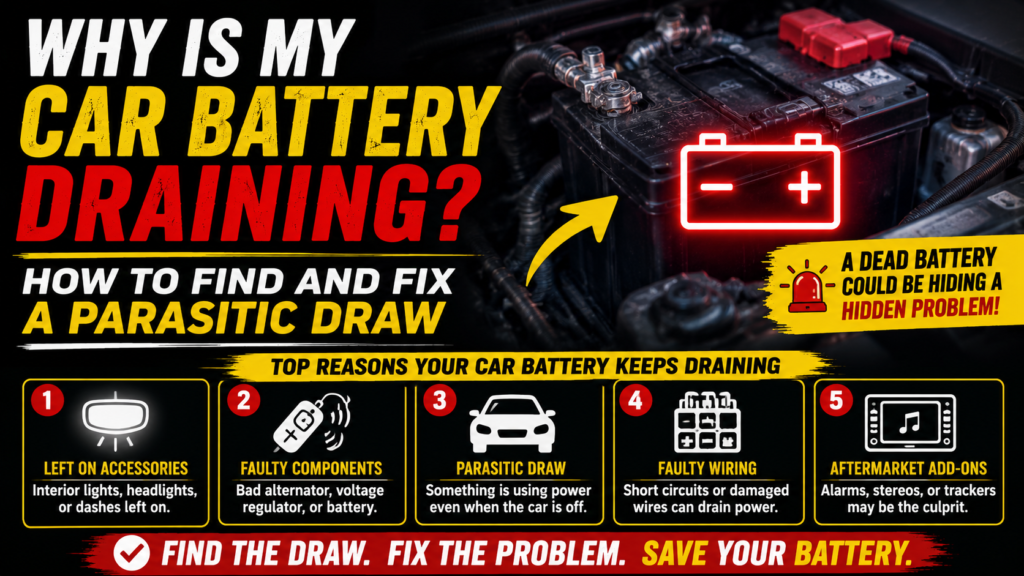
You walk out to your car in the morning and it’s dead. You jump it, drive around, park it, and the next morning it’s dead again. The battery tests fine. The alternator tests fine. Something is draining it overnight — and you have no idea what. Once an overnight drain leaves you with a no-start, what repeated clicking indicates shows what the sound can reveal before you begin testing.
This is called a parasitic draw, and it’s one of the most frustrating car problems to track down because it leaves no warning lights, no obvious symptoms, and no codes. It just quietly kills your battery every time the car sits. This guide walks you through exactly how to find it and fix it — step by step, at home, with basic tools.
Quick Answer: A parasitic draw is something in your car pulling power when the engine is off. Normal draw is under 50 milliamps. Anything above that is draining your battery. Common culprits include a trunk or glove box light staying on, a faulty relay, an aftermarket accessory wired incorrectly, or a module that won’t go to sleep. A multimeter in current mode finds it by pulling fuses one at a time. The same current-measurement principles apply when tracking an unexpected drain in an RV: RV parasitic drain testing.
First — Rule Out the Obvious
Before assuming you have a parasitic draw, eliminate the simple explanations first. They account for more dead battery situations than most people realize.

The battery itself is failing. A battery that’s on its last legs holds a surface charge well enough to start the car once but loses that charge quickly when sitting. It looks exactly like a parasitic draw — dead in the morning, starts fine after a jump. Test the battery first with a proper battery tester before spending hours chasing a draw that doesn’t exist. The ANCEL BA101 battery tester tells you battery health, alternator output, and starter draw in under two minutes — it’s the right first step every time.

The alternator isn’t charging properly. An alternator that’s undercharging sends the battery into each key-off cycle already partially depleted. Normal overnight draw then drops it below starting threshold. Test charging voltage at the battery with the engine running — it should read 13.7–14.7 volts. A digital multimeter does this in seconds.
Short trips aren’t recharging the battery. If you only drive 5–10 minutes at a time, the alternator may not have enough run time to fully recharge what the starter used. Batteries that never fully charge sulfate over time and eventually won’t hold a charge at all. This isn’t a draw — it’s a usage pattern problem.
If battery and alternator both test healthy and you’re driving reasonable distances, then yes — you likely have a parasitic draw.


What Is a Normal Parasitic Draw
Every modern vehicle draws some power when it’s off. The clock keeps running. The alarm system stays armed. The ECU maintains its memory. The keyless entry receiver stays awake listening for your key fob. All of this is normal and expected.
The threshold for normal parasitic draw is generally accepted as 50 milliamps (0.050 amps) or less. Some manufacturers specify even tighter — 25–35 milliamps for some newer vehicles with more sophisticated sleep systems. Anything above 50 milliamps sustained after the vehicle has gone through its full sleep cycle is considered an abnormal draw worth investigating.
Important note: many modern vehicles take 10–45 minutes after being turned off for all modules to fully enter sleep mode. Measuring draw immediately after shutting the car off will show elevated current that drops as modules go to sleep. Always wait at least 20–30 minutes before taking your baseline draw measurement.


What You Need to Find a Parasitic Draw
You need a digital multimeter capable of measuring DC milliamps — most quality meters including the AstroAI TRMS multimeter handle this. You need your vehicle’s fuse box diagram — usually printed on the inside of the fuse box cover or in the owner’s manual. And you need patience, because finding a draw is a process of elimination rather than a single test.
A fuse puller or small needle-nose pliers helps with pulling fuses without damaging them. A headlamp keeps your hands free while working in the fuse box. That’s it — no specialized equipment required.
How to Measure Parasitic Draw Step by Step
Step 1: Make sure the vehicle is fully off — no interior lights on, all doors closed, everything powered down. If your car has a trunk light or under-hood light, confirm they’re off when closed.
Step 2: Set your multimeter to DC current — the amps or milliamps setting. On most meters this requires moving the red probe to the dedicated current input jack, usually labeled A or mA. This is critical — measuring current with the probe in the voltage jack blows the meter’s internal fuse instantly.
Step 3: Disconnect the negative battery cable.
Step 4: Connect the multimeter in series between the negative battery cable and the negative battery terminal — red probe to the cable, black probe to the terminal (or reverse depending on your meter’s convention). The meter is now measuring all current flowing out of the battery.
Step 5: Wait 20–30 minutes without opening any door or touching anything. Opening a door wakes up modules and spikes the reading. Set the meter down and leave it.
Step 6: After the wait, read the current. Under 50 milliamps — normal. Over 50 milliamps — you have a draw to find.



How to Find Which Circuit Is Causing the Draw
This is where the fuse pull method comes in. With the multimeter still connected and reading elevated current, go to your fuse box — most vehicles have one under the hood and one inside the cabin.
Pull fuses one at a time. When you pull the fuse for the circuit causing the draw, the current reading on your multimeter will drop significantly — often by 100–500 milliamps or more. That’s your circuit.
Work systematically. Pull fuses in groups first — all the engine bay fuses, then all the interior fuses. When the draw drops, you’ve found the group. Then pull fuses in that group individually to isolate the exact circuit.
Don’t skip the big ones. Some draws come through high-current fuses or fusible links rather than standard blade fuses. If pulling all the blade fuses doesn’t drop the reading, check the large fuses and fusible links in the under-hood box.
Once you’ve identified the circuit by name from the fuse box diagram, you know which system to investigate. “Radio” means the audio system. “BCM” means the body control module. “Trunk” means the trunk light or trunk release circuit. That label points you directly to the component to inspect.
Most Common Causes of Parasitic Draw
Interior Lights That Don’t Turn Off
The trunk light, glove box light, and under-hood light are all triggered by switches that can fail or get stuck in the on position. A trunk light that stays on with the trunk closed drains the battery completely overnight. Check each one by opening the compartment in the dark — if the light is on, you found your draw. The switch that triggers the light is usually a simple plunger switch that can be tested or replaced cheaply.
Aftermarket Electronics Wired Incorrectly
Aftermarket stereos, amplifiers, dash cams, GPS units, and remote starters are common parasitic draw culprits — especially if they were installed without running a switched power wire. An accessory that’s wired directly to the battery rather than to a switched circuit stays on all the time, even with the key out. A dash cam drawing 200 milliamps continuously will drain a typical car battery in 2–3 days.
Faulty Relays

Relays are switches that control high-current circuits — the cooling fan relay, the fuel pump relay, the horn relay, and dozens of others. When a relay fails stuck in the closed position, it keeps power flowing to whatever it controls even with the key off. A cooling fan that’s running with the engine off is a classic stuck relay symptom — and it’ll drain your battery in hours. A cooling fan relay problem can also cause overheating when the fan fails to operate at the right time; see cooling fan relay problems for the symptoms and checks.
Modules That Won’t Sleep
Modern vehicles have dozens of electronic control modules — the body control module, the infotainment system, the telematics module, the TPMS module, and more. Each one is supposed to enter a low-power sleep state shortly after the car is turned off. When one fails to sleep — due to a software glitch, a failed component, or a triggered sensor keeping it awake — it draws full operating current all night. This is increasingly common on newer vehicles and often requires a dealer scan tool to diagnose properly.
Faulty Door Switches
The door ajar switch tells the car when a door is open — triggering interior lights, keeping the BCM awake, and preventing the car from going into full sleep mode. A faulty switch that reads “open” all the time keeps multiple systems awake indefinitely. If your interior light flickers when you drive over bumps, or if the door ajar warning light comes on randomly, a door switch is worth inspecting.
Weak or Failing Alternator Diode
Alternators contain diodes that convert AC current to DC and prevent battery power from flowing backward through the alternator. When a diode fails, current can flow from the battery through the alternator even with the engine off — a draw that shows up on the battery circuit but doesn’t correspond to any fuse. Testing for this requires isolating the alternator from the circuit during draw testing.


How to Test for an Alternator Diode Draw
With the multimeter measuring draw and all fuses still in place, disconnect the alternator output wire from the alternator — the large wire on the back of the alternator that goes to the battery positive terminal. If the draw drops significantly when you disconnect this wire, a bad alternator diode is your problem. The alternator needs to be rebuilt or replaced.

This is separate from testing whether the alternator charges correctly — a diode that’s failed in the drain direction can still produce adequate charging voltage while simultaneously draining the battery when the engine is off. When the charging system may be involved, testing alternator charging voltage helps distinguish a drain-side diode failure from an alternator that is undercharging.
Fixing the Draw Once You’ve Found It
The fix depends entirely on what you find. A stuck trunk light switch is a $10–$30 part and a 30-minute job. An aftermarket accessory wired to constant power needs its wiring corrected to a switched circuit — a job for whoever installed it or a competent audio shop. A faulty relay is typically a $10–$20 part that unplugs and replaces in minutes. A module that won’t sleep may need a software update from the dealer, a replacement module, or diagnosis of what’s keeping it awake.
If pulling fuses doesn’t isolate the draw to a specific circuit — or if the draw is coming through the alternator — the diagnosis becomes more involved and a shop with proper scan tools may be the right call.



Keeping Your Battery Healthy While You Diagnose
If you’re dealing with a recurring dead battery while trying to find the draw, a battery maintainer or trickle charger keeps the battery topped off between drives. This is especially important in cold weather where battery capacity drops significantly and even a modest draw causes faster discharge.

The NOCO GB40 jump starter kept charged in the car handles dead battery situations without needing a second vehicle — useful when you’re mid-diagnosis and the battery dies unexpectedly while the car is sitting in the driveway.
Frequently Asked Questions
How do I know if it’s the battery or a parasitic draw?
Test the battery first with a proper battery tester. If the battery tests good — healthy CCA, no bad cells — then test for draw. If the battery tests weak or bad, replace it first and see if the problem resolves before assuming you have a draw. A failing battery and a parasitic draw can coexist, which is why sequence matters. Before diagnosing the draw, review when a battery is failing to distinguish normal battery aging from problems caused by the vehicle.
How fast will a parasitic draw drain my battery?
Depends on the draw size and battery capacity. A 50 milliamp normal draw on a 50 amp-hour battery takes about 1,000 hours to drain completely — weeks. A 500 milliamp draw drains the same battery in about 100 hours — four days. A 2-amp draw from a stuck relay drains it in 25 hours. A stuck interior light drawing 5 amps kills the battery in 10 hours.
Can a bad ground cause a parasitic draw?

Yes. A corroded or loose ground connection creates resistance that can cause modules to behave erratically — staying awake longer than they should or drawing more current than normal. Clean, tight ground connections are part of healthy electrical system maintenance. Clean battery terminals and ground straps are a good starting point for any electrical complaint.
My car has a start-stop system — does that affect this?
Vehicles with automatic start-stop systems use enhanced AGM batteries designed to handle deeper discharge cycles. These batteries can tolerate more draw than a standard flooded battery before damage occurs — but they still have limits, and a significant parasitic draw will eventually kill them too.
Will disconnecting the battery fix it?
Temporarily — disconnecting the battery stops the draw and preserves the charge. But it also resets your radio presets, power window positions, and sometimes causes the engine management system to relearn parameters over the next few drive cycles. It’s not a fix, just a way to preserve battery life while you diagnose.
How much does it cost to diagnose a parasitic draw at a shop?
Typically $75–$150 for the diagnostic hour. The fix cost depends entirely on what’s found. Shops with scan tools that monitor individual module current draw can often isolate the problem faster than the manual fuse pull method — worth the diagnostic fee on newer vehicles where dozens of modules are involved.
About the Author: Ryan Fowler
Ryan is a former fleet mechanic who spent twelve years maintaining commercial vehicles before transitioning to writing about automotive issues for regular drivers. He’s worked on everything from economy sedans to full-size diesel trucks and has a particular obsession with electrical gremlins that make no sense until suddenly they do. Ryan contributes to WhyIsMyCar.com because most car content online is either too technical or too vague — he aims for the middle ground where people actually learn something.