I’ve had my 2015 GMC Sierra for about two weeks. It’s new to me, I really like the truck, and today the check engine light came on.
Of course my first thought was, Oh no. What did I just buy?
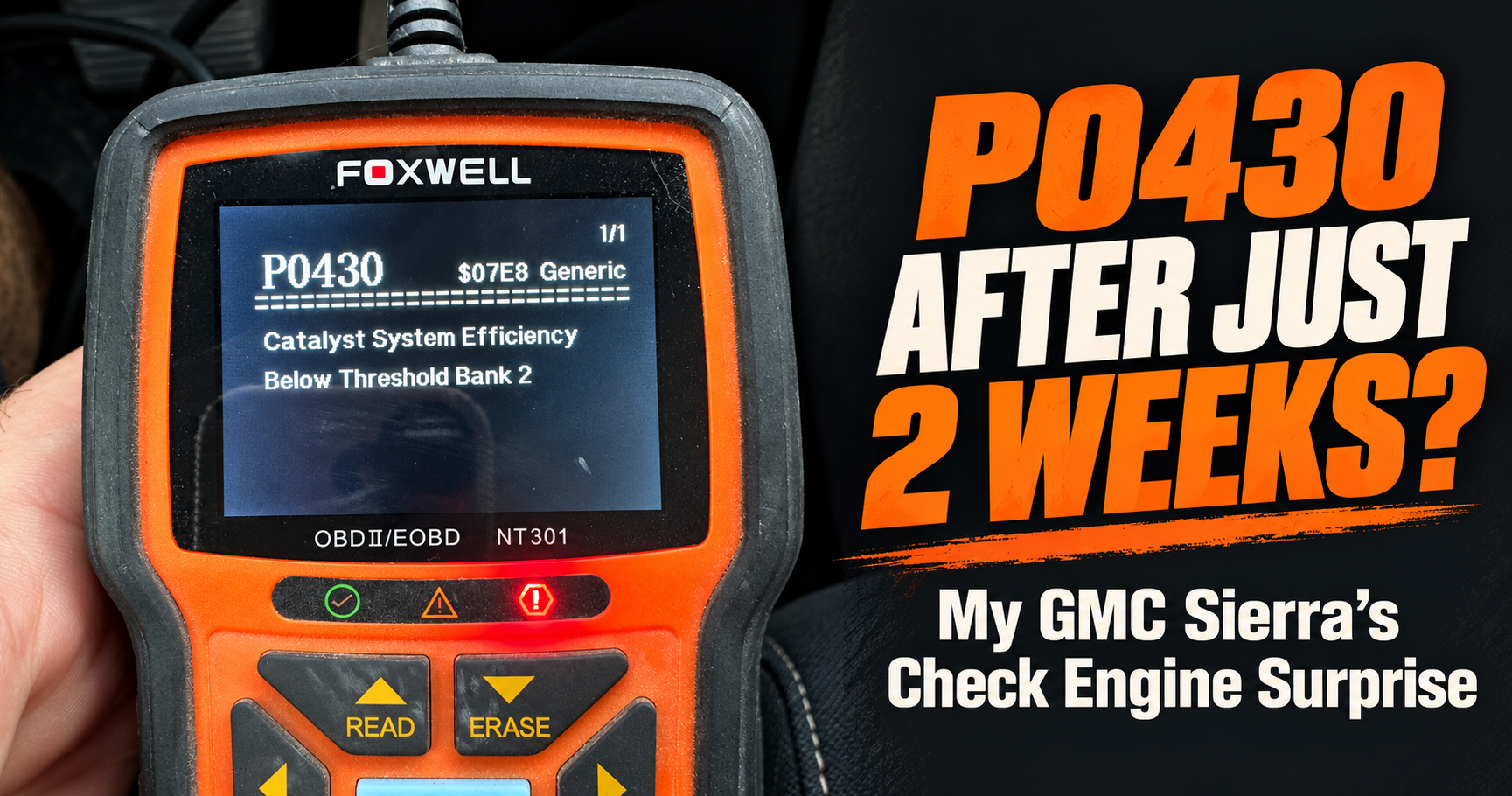
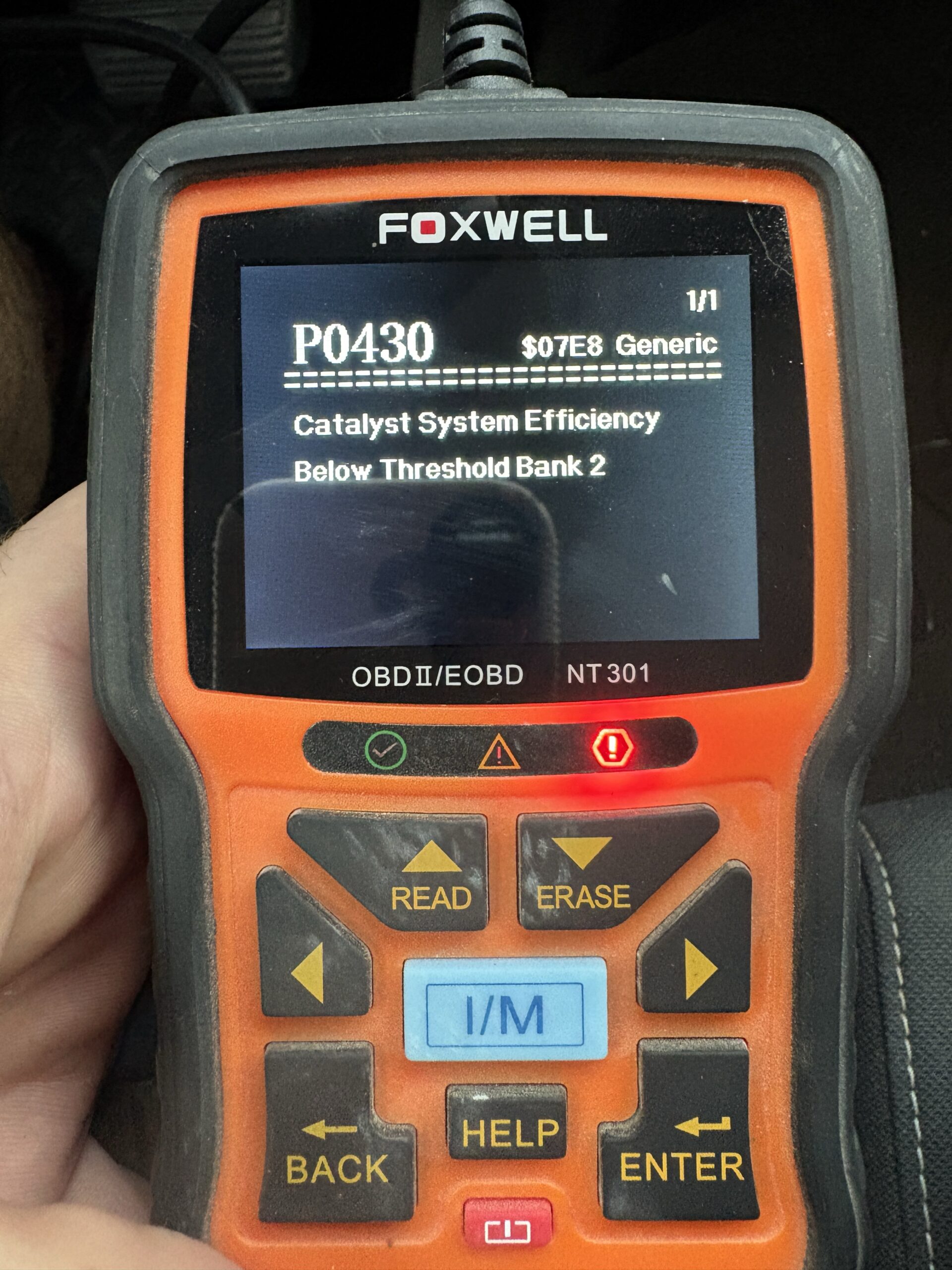
I plugged in my little code reader, and it showed P0430: Catalyst System Efficiency Below Threshold Bank 2. I took a picture of the screen because I knew I’d forget the exact wording the second I unplugged it.
That description sounds expensive. It mentions the catalytic converter, which is a part nobody wants to replace right after buying a used truck. But a code reader tells me what the truck detected, not which part I should order.
Here’s what P0430 means, how worried I should be, and what I want checked before anybody sells me a converter.
What does P0430 mean on a GMC Sierra?
P0430 means the truck’s computer decided that the Bank 2 catalytic-converter system isn’t performing as efficiently as expected.
The catalytic converter is part of the exhaust system. It helps clean up the gases coming out of the engine. The truck monitors how that system performs and turns on the check engine light when a test falls below its threshold.
“Bank 2” identifies one side of the engine on a V-shaped engine. It does not mean the truck has two engines, and it doesn’t tell me which part has failed.
I’m keeping the exact code, P0430, in my notes. If I talk to a shop, that’s more useful than saying, “It had some kind of catalytic-converter warning.”
Does P0430 mean my catalytic converter is bad?
Possibly, but I don’t know that yet.
A converter that has lost efficiency can set this code. So can a problem that affects the readings the truck uses to judge the converter, or an engine problem that has been making the converter’s job harder.
That distinction matters when a replacement could be a substantial repair. I don’t want to buy the most expensive part in the exhaust system because a basic scanner displayed the word “catalyst.”
There’s a particularly useful GMC-related detail here. GM’s technical guidance on P0420 and P0430 tells technicians working on some 2015 and earlier GM gasoline trucks to inspect a poor electrical crimp or ground connection on the affected engine bank. That doesn’t mean my truck has that fault. It does mean a converter should not be treated as the only possible answer.

Is it safe to drive with P0430?
I’d judge that by the light and the way the truck is running, not by the code alone.
If the check engine light is steady
GMC says a steady check engine light means an emissions-control malfunction was detected and diagnosis or service may be needed.
If my truck starts normally, drives normally, and the light stays steady, I’d avoid putting off the diagnosis, but I wouldn’t treat P0430 alone as proof that I need to park it immediately. I’d also hold off on a long trip or towing until I understood what was happening.
A steady light still matters. The truck could be producing more emissions, using more fuel, or developing another problem that needs attention.
If the check engine light is flashing
That changes my answer. GMC says a flashing light indicates a misfire that could damage the emissions system.
I’d ease off the throttle, avoid hard acceleration, and find a safe place to stop. If the light kept flashing or the truck ran poorly after a restart, I’d arrange prompt service instead of continuing to drive it around to see whether it cleared up.
I haven’t established in this article whether my light was steady or flashing. That’s a detail I want to record along with the code, because it changes how urgently I’d act.
The red warning symbol on my scanner scared me. Is that another truck warning?
The Foxwell reader in my photo has a red symbol lit below its screen. That’s on the scan tool, separate from the check engine light in the truck’s dashboard.
I wouldn’t use the color of the reader’s symbol to decide whether the engine is actively being damaged. I’d look at the truck’s warning light, how it runs, and whether there are other codes.
The screen also says 1/1. That tells me I’m looking at one displayed code entry. It doesn’t prove P0430 is the only problem the truck could have or that the cause has already been identified.


What I’d check before paying for a converter
The first useful thing was reading and photographing the code. Now I want to keep that information instead of erasing it right away.
I’d look for any other codes
A basic code reader may offer separate menus for stored, pending, and permanent codes. I’d look through what mine can show and write down anything else it finds.
A misfire code, fuel-system code, or oxygen-sensor code would give a mechanic more to work with. Even if P0430 is the only code showing now, that’s worth noting.
I wouldn’t clear the code just to make the check engine light disappear before it’s diagnosed. Clearing it can remove information that helps explain when the fault happened, and the light may simply come back once the truck repeats its test.
I’d pay attention to how the truck runs
Does it idle smoothly? Does it hesitate when accelerating? Is it down on power? Did the fuel mileage suddenly change? Is there a new exhaust noise or smell?
Those observations won’t diagnose a catalytic converter by themselves. They can tell a shop whether this looks like an isolated efficiency code or part of a larger running problem.
I’d write down whether the light came on soon after filling up, during a longer drive, or after the truck had been sitting. The timing may or may not matter, but it’s easier to record it today than remember it next week.
I’d listen for an exhaust leak
A leak in the exhaust ahead of or near the parts being monitored can complicate a catalyst diagnosis. A ticking or puffing noise, especially when the engine is cold, would be worth mentioning to a mechanic.
I wouldn’t crawl under a running truck or put my hands near hot exhaust parts to investigate it. Listening from a safe position is enough for my first check.
I’d ask about the oxygen-sensor readings
The truck uses sensor information to monitor the catalytic-converter system. An oxygen sensor or its wiring could be part of the problem, though I wouldn’t replace one simply because P0430 appeared.
A shop with the right equipment can examine live data and run the appropriate tests. My handheld reader is great for finding out which code appeared. It isn’t a complete diagnosis of why it appeared.
I’d ask them to check the affected bank’s wiring and grounds
This is the less obvious check I don’t want to miss. GM’s technician guidance specifically calls out possible poor crimps or ground-connection problems when P0420 or P0430 appears on certain GM vehicles, including gasoline trucks from this period.
I wouldn’t tell a mechanic that I’ve found the answer. I’d say, “It has P0430. Can you check for other codes, exhaust leaks, sensor and fuel-control issues, and the Bank 2 wiring and grounds before condemning the converter?”
That’s a reasonable request for a diagnosis, not a request to throw parts at it.
Would a loose gas cap cause this exact code?
A loose gas cap can turn on a check engine light, and GMC mentions checking it in the owner’s manual when the light is steady.

But P0430 is a catalyst-efficiency code, not the usual code I’d expect from an evaporative-system leak at the gas cap. I can make sure the cap is seated properly, but I wouldn’t call that the fix for P0430 without further evidence. If your scanner instead reports P0455 large EVAP leak, the diagnostic questions are different because the code concerns the fuel-vapor system rather than catalyst efficiency.
That’s why reading the code was useful. “Check engine” covers a lot of different problems. The number on the scanner narrows the conversation considerably.


Should I erase P0430 and see if it comes back?
I understand the temptation. The truck looks and feels a lot nicer without an orange light staring at me.
For now, I’d leave the code alone until I’ve recorded the details and decided how to get it checked. Erasing it doesn’t repair anything. It may also reset emissions readiness monitors, which can matter if the truck needs an inspection.
If a shop repairs the actual cause, clearing the code and confirming the truck completes its tests without P0430 returning makes sense. That’s different from clearing it before anyone has looked at the problem.
What if a shop immediately says I need a catalytic converter?
I’d ask what testing led them there.
Maybe the converter really has failed. A 2015 truck with miles on it can need exhaust repairs. But I’d want to know whether they checked for other codes, engine-running problems, exhaust leaks, sensor readings, and relevant electrical issues first.
I’d also ask whether they found anything that might damage a replacement converter. If the engine is misfiring or running incorrectly, installing a new converter without addressing the cause could leave me paying for the same problem again.
A clear explanation of what failed and why is worth more to me than a quote based only on a code-reader screen.
What I know about my truck today
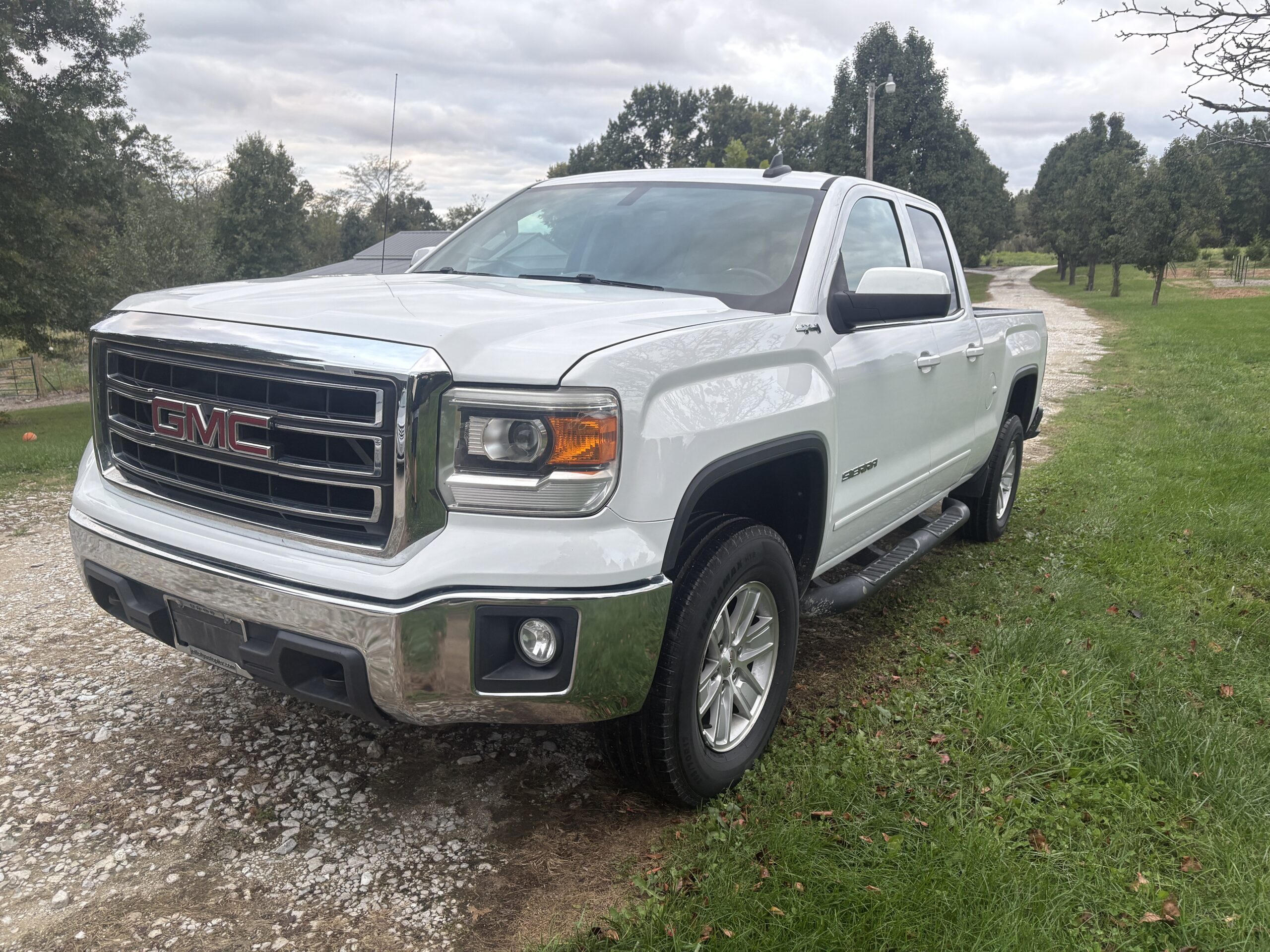
My truck is a 2015 GMC Sierra 4×4 that I bought about two weeks ago. Today the check engine light appeared, and my Foxwell OBD-II reader displayed P0430, Catalyst System Efficiency Below Threshold Bank 2.
That’s what I can say firsthand. I haven’t diagnosed the cause or replaced a part. I’ll update this article when I know what was actually wrong, what fixed it, and what it cost me.
For now, I’m glad I plugged in the reader instead of guessing from the light alone. P0430 gives me a place to start. It does not yet give me a bill for a catalytic converter.
About the author: Daxon Weaver owns the 2015 GMC Sierra in this article. He shares what happens with his own vehicles, including the questions he has before paying for a repair.